


 DENAN JIN
金 徳男
Faculty of Medicine
Department of Pharmacology

R&D stage

Point
-
Association between mast cell-derived chymase activation and neointimal hyperplasia in PTFE vascular grafts
-
Evaluation of the inhibitory effect of chymase inhibitor-coated PTFE vascular grafts on neointimal hyperplasia
-
Toward the clinical application of chymase inhibitor-coated PTFE vascular grafts
Keyword
Renal dialysis, PTFE vascular graft, Vascular access failure, Chymase inhibitor, Coating
Background
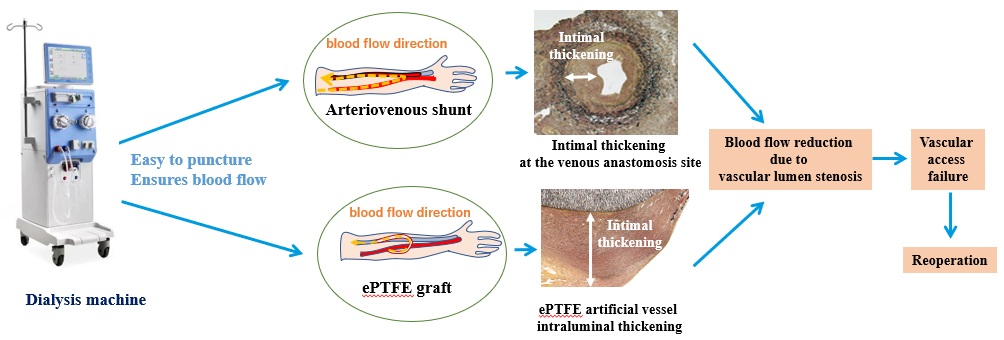
In recent years, advances in dialysis therapy have significantly extended the lifespan of patients with end-stage renal disease, from more than a decade to several decades. Hemodialysis patients are required to undergo treatment three times per week. To achieve efficient blood purification within a limited period, it is essential to secure vascular access that is both easy to cannulate and capable of maintaining sufficient blood flow.
Therefore, patients typically undergo arteriovenous fistula (AVF) creation or implantation of a polytetrafluoroethylene (PTFE) vascular graft (Fig. 1). However, regardless of the type of vascular access, neointimal hyperplasia often develops over time, leading to luminal stenosis and insufficient blood flow. As a result, repeated reconstruction of new vascular access routes becomes necessary.
In Japan, the medical costs associated with such repeated interventions have been increasing year by year, placing a significant burden on the healthcare insurance system. Furthermore, these procedures impose substantial physical and financial burdens on patients. Despite these challenges, effective therapeutic strategies for vascular access failure have not yet been established.
Overview and Progress
Chymase is one of the enzymes stored in mast cells and not only converts angiotensin (Ang) I to Ang II, similar to angiotensin-converting enzyme, but also contributes to the activation of transforming growth factor-β1 (TGF-β1) and matrix metalloproteinases (MMPs).
We have previously established canine models of arteriovenous fistula and PTFE vascular graft implantation to investigate the effects of a chymase inhibitor on neointimal hyperplasia (related publications 1–3). Our results demonstrated that long-term oral administration of a chymase inhibitor significantly suppressed neointimal formation, suggesting its potential as a preventive agent for vascular access failure in dialysis patients. Furthermore, through these studies, we revealed that the migration of fibroblasts from the adventitial side into the lumen plays a critical role in neointimal hyperplasia following PTFE graft implantation.
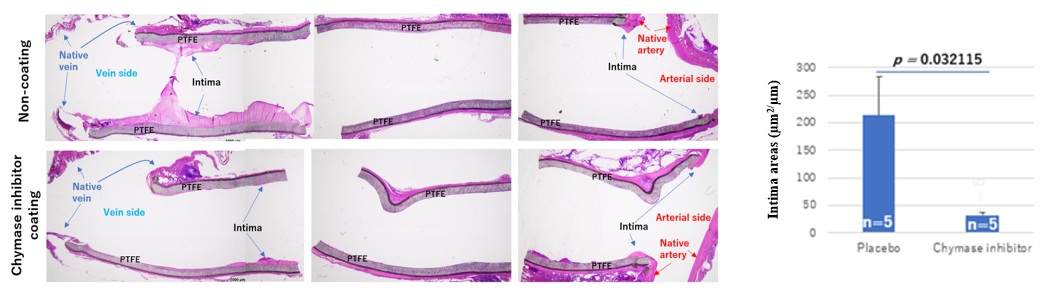
Based on these findings, we hypothesized that coating PTFE vascular grafts with a chymase inhibitor could suppress such fibroblast migration. In collaboration with Kansai University, we successfully developed a chymase inhibitor–coated PTFE vascular graft. When coated and non-coated PTFE grafts were implanted into ten dogs, neointimal hyperplasia was found to be significantly reduced in the coated group at six months after implantation (Fig. 2).
Market potential
According to a facility survey conducted at the end of 2022, the number of dialysis patients in Japan was 347,474, corresponding to 2,781 patients per million population. Among these, 89.7% are managed using arteriovenous fistulas (AVFs) as vascular access. In contrast, patients with poor superficial vessels or conditions such as arterial occlusive disease require PTFE vascular graft implantation, which accounts for approximately 7.1% of cases. This proportion is considered lower than that reported internationally.
In general, AVFs provide longer patency and are therefore the preferred option for dialysis patients. However, when PTFE vascular grafts are used, their patency duration is typically much shorter. Approximately 50% of vascular access routes using artificial grafts develop luminal stenosis within one year due to neointimal hyperplasia, resulting in decreased blood flow and eventual vascular access failure. The patency rate at two years falls to less than 10%, necessitating the creation of new vascular access routes.
The total cost required to establish a new vascular access route is approximately 300,000 yen, with an out-of-pocket expense of around 90,000 yen under a 30% copayment.
Proposed Form of Social Implementation
The use of PTFE vascular grafts as vascular access routes for dialysis patients has been increasing year by year, accompanied by a rise in the number of reinterventions required due to vascular access failure. This trend imposes a significant burden on both patients and the healthcare insurance system.
As demonstrated in our research, chymase inhibitor-coated PTFE vascular grafts markedly suppress neointimal hyperplasia compared with non-coated grafts, as observed six months after carotid arteriovenous implantation in canine models. These findings suggest that clinical application of chymase inhibitor coating technology has the potential to substantially prolong the patency of PTFE vascular access grafts in dialysis patients.
Furthermore, in our previous studies evaluating the effects of oral administration of chymase inhibitors, the treatment significantly reduced not only neointimal hyperplasia within the graft lumen but also thrombus formation at the sites of intimal thickening compared with untreated groups. These results indicate that this approach may also overcome one of the major drawbacks of PTFE grafts—their high thrombogenicity.
Taken together, coating PTFE vascular grafts with chymase inhibitors is expected to significantly extend their usable lifespan in clinical practice. This advancement may not only reduce the economic burden on patients but also contribute to alleviating the growing financial strain on healthcare systems.
Message to Potential Partners
Japan is home to many outstanding medical device manufacturers and offers a well-established range of research funding programs. To translate our findings into clinical practice, collaboration among academia, industry, and government is essential. We are therefore committed to promoting joint research with interested manufacturers and securing competitive research funding.
Currently, PTFE vascular grafts are predominantly used for dialysis both in Japan and internationally. However, the porous structure inherent to PTFE is closely associated with the mechanism of neointimal hyperplasia. We have demonstrated that, following PTFE graft implantation, fibroblasts migrate from the adventitial side into the lumen through these interstitial spaces, contributing significantly to intimal thickening.
Based on these findings, we believe that the development of novel biocompatible vascular graft materials without a porous structure, such as that of PTFE, is essential to prevent neointimal hyperplasia after implantation. In our previous studies, we compared PTFE grafts with non-porous, middle-layer grafts lacking such interstitial structures in a canine implantation model. Our results showed that these non-porous grafts effectively suppressed fibroblast migration into the lumen and significantly reduced neointimal hyperplasia (related publication 3).
However, these non-porous grafts were relatively rigid and therefore less suitable for surgical handling, ultimately resulting in their discontinuation. At present, the global market for PTFE vascular grafts is largely dominated by a single U.S.-based company. We believe that the development of a novel graft capable of effectively suppressing neointimal hyperplasia has the potential to disrupt this monopolized market and create new value in the field.
Related Publications and Intellectual Property
- Effect of chymase inhibition on the arteriovenous fistula stenosis in dogs. Jin D, Ueda H, Takai S, Okamoto Y, Muramatsu M, Sakaguchi M, Shibahara N, Katsuoka Y, Miyazaki M. J Am Soc Nephrol 16, 1024-1034, 2005
- Roles of chymase in stenosis occurring after polytetrafluoroethylene graft implantations. Jin D, Ueda H, Takai S, Muramatsu M, Furubayashi K, Ibaraki T, Kishi K, Katsuoka Y, Miyazaki M. Life Sci 29(81), 1291-1300, 2007
- Outside fibroblasts play a key role in the development of inn er neointima after the implantation of polytetrafluoroethylene grafts. Jin D, Takai S, Li Z, Sakonjo H, Otsuki Y, Shibayama Y, Miyazaki M. J Pharmacol Sci 119, 139-49, 2012
[Patent] Pending