


朝井 章
Faculty of Medicine
Laboratory of Advanced Liver Therapeutics and Research
Central Clinical Laboratory
Liver Center

R&D stage

Point
- Kupffer cells in the liver assume a specific activated phenotype in liver cirrhosis.
- Kupffer cells in cirrhotic hosts represent a potential target for gene therapy aimed at resolving hepatic fibrosis.
- Consideration of drug delivery systems is expected to improve nucleic acid transport efficiency and stability, thereby enhancing therapeutic efficacy.
Keyword
Liver cirrhosis, Kupffer cells, Gene therapy, CCL 1 antisense oligodeoxynucleotides (CCL 1 AS ODN), Drug delivery system (DDS)
Background
Liver cirrhosis, which represents the terminal stage of chronic liver disease, progresses as a result of various etiological factors, including viral hepatitis infection, alcohol consumption, autoimmune diseases, and non-alcoholic steatohepatitis. These causes lead to repeated cycles of hepatocyte injury and regeneration associated with chronic inflammation. Consequently, regenerative nodules are formed within the liver, surrounded by fibrotic tissue, resulting in liver stiffening and ultimately cirrhosis.
A hallmark of cirrhosis is portal hypertension caused by the progression of hepatic fibrosis. Elevated portal pressure is known to induce various intrahepatic and extrahepatic complications, which constitute the major causes of death in patients with liver cirrhosis.
Currently, approximately 20 million individuals worldwide are estimated to suffer from liver cirrhosis, with an annual mortality of around 800,000 cases. The fundamental pathological feature of cirrhosis is hepatic fibrosis; however, once established, fibrotic tissue has long been considered irreversible, and no established therapy capable of fully restoring normal liver architecture is currently available.
Therefore, conventional therapeutic approaches for cirrhosis have mainly focused on treating the underlying causes. While remarkable progress has been achieved in the treatment of certain etiologies, such as viral hepatitis, effective therapies remain lacking for fibrosis-driven diseases including alcoholic liver disease, non-alcoholic steatohepatitis, and autoimmune liver diseases.
In recent years, there has been an increasing demand for therapeutic strategies that directly target the elimination of hepatic fibrosis, a common pathological feature among cirrhotic patients. However, most existing antifibrotic approaches target collagen, the principal component of fibrotic tissue. Since collagen is the most abundant protein in the human body and plays essential roles in maintaining tissue structure as well as in wound healing and tissue repair, its inhibition may cause systemic side effects, making it a challenging therapeutic target.
Similarly, approaches targeting hepatic stellate cells or myofibroblasts, which produce collagen, have not yet led to successful drug development. This is because these cells are not specific to the liver but are widely distributed across multiple organs, and their inhibition may also result in adverse effects.
At present, no clinically available antifibrotic therapy exists worldwide, highlighting the urgent need for the development of novel therapeutic strategies in this field.
Overview and Progress
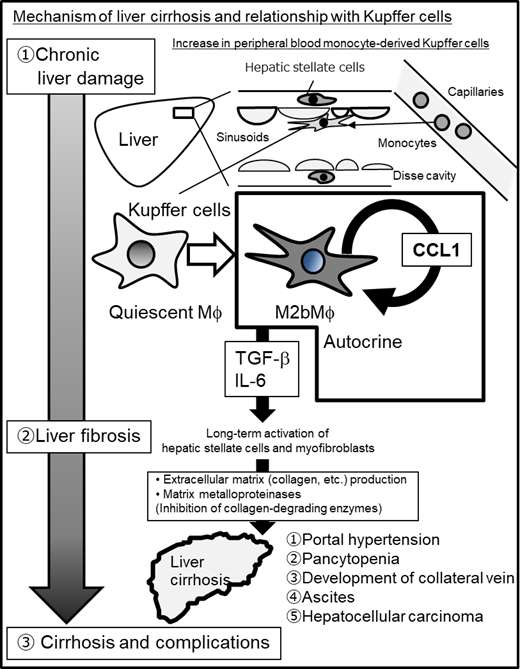
We are focusing on Kupffer cells, the liver-resident macrophages, and are conducting research aimed at developing a novel gene therapy that can not only prevent hepatic fibrosis but also promote its resolution.
Among activated macrophage subsets, M2a and M2c macrophages are known to lose their characteristics within a relatively short period, whereas M2b macrophages persist over a longer duration. In our previous studies, we demonstrated that most activated Kupffer cells present in chronically inflamed livers are in fact peripheral blood monocyte–derived Kupffer cells that infiltrate the liver in response to inflammation, and that these cells possess the characteristics of M2b macrophages.
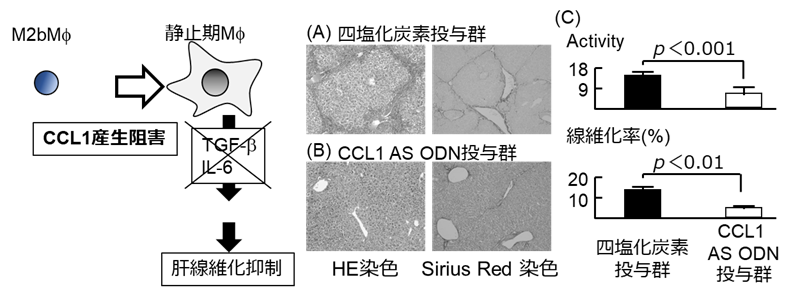
Furthermore, we focused on CCL1, a chemokine secreted by activated M2b macrophages, and revealed that CCL1 prolongs the survival of M2b macrophages themselves. We then showed that modifying the CCL1-producing capacity of M2b macrophages באמצעות gene therapy using CCL1 antisense oligodeoxynucleotides (CCL1 AS ODN) markedly reduces the number of M2b macrophages by inducing their reversion to a quiescent macrophage state, thereby suppressing macrophage activation in the local tissue environment as a whole (J. Leukoc. Biol. 2012; 92: 859–867).
Based on these findings, we hypothesized that, in mice with chronic liver injury, M2b macrophages persist for prolonged periods and strongly promote hepatic fibrosis by continuously activating quiescent hepatic stellate cells and myofibroblasts. We further proposed that gene therapy using CCL1 AS ODN might ameliorate hepatic fibrosis (Fig. 1). In fact, when this gene therapy was applied to cirrhotic mice, suppression of newly forming hepatic fibrosis was observed (Fig. 2).
At present, to improve target-cell delivery efficiency and the stability of nucleic acids, we are investigating a drug delivery system carrying CCL1 AS ODN and evaluating its toxicity and therapeutic efficacy.
Previous therapeutic approaches and candidate drugs have not directly targeted hepatic fibrosis itself, but rather collagen, its major structural component, or collagen-producing cells. As a result, they may cause various adverse effects in other organs and throughout the body, such as diarrhea and skin disorders, which has hindered their clinical development. A therapy capable of resolving hepatic fibrosis would represent a fundamentally new treatment for liver cirrhosis, and we expect that this research will contribute to its realization.
Market potential
Preliminary experiments have demonstrated not only a therapeutic effect in eliminating pre-existing hepatic fibrosis, but also a preventive effect against newly developing fibrosis. Therefore, this approach may have the potential to serve as a novel therapeutic option not only for the approximately 20 million patients with liver cirrhosis worldwide, but also for other fibrosis-related diseases for which effective disease-specific therapies remain unavailable, including autoimmune hepatitis (800,000 patients), alcoholic liver disease (1 million patients), and non-alcoholic steatohepatitis (approximately 400 million patients).
The academic significance of this therapy lies in its potential to suppress the progression of hepatocellular carcinoma and decompensated liver cirrhosis, both of which are major complications associated with hepatic fibrosis. Such effects may reduce the need for invasive and costly interventions such as liver transplantation, hepatic resection, and anticancer treatment.
In addition to the social benefits of helping patients maintain employment and quality of life, this therapy is also expected to substantially reduce medical costs. Even in Japan and the United States alone, it may lead to economic benefits on the scale of several billion dollars in annual healthcare savings.
Proposed Form of Social Implementation
Elucidation of the mechanisms underlying antifibrotic therapy is expected to provide the possibility of avoiding liver transplantation, thereby contributing to substantial reductions in healthcare costs and addressing the critical shortage of donor organs.
The drug delivery system (DDS) developed in this study is not limited to CCL1 antisense oligodeoxynucleotides (CCL1 AS ODN), but can also be applied to other therapeutic agents. This versatility is expected to promote the advancement of nucleic acid–based therapeutics and to create new market needs in this field.
Furthermore, technologies that modulate the activation phenotype of Kupffer cells may lead to the development of novel biomarkers, opening new avenues for disease diagnosis and therapeutic monitoring.
The strategy of modifying the properties of a specific immune cell subset, M2b macrophages, to regulate the immune environment is also applicable to the development of treatments for cancer immunotherapy and autoimmune diseases. In addition, molecular-level elucidation of the mechanisms underlying the improvement of hepatic fibrosis is expected to facilitate the development of novel therapies for other fibrotic diseases, such as idiopathic pulmonary fibrosis, heart failure with preserved ejection fraction, and renal fibrosis.
Moreover, this therapeutic approach may be applicable to the control of diseases in which M2b macrophages are implicated, such as systemic lupus erythematosus (SLE) and severe burn-related conditions.
Message to Potential Partners
To advance research toward social implementation, we are seeking collaborative partners among researchers and companies with expertise and experience in drug discovery.
In particular, we welcome companies with the knowledge, infrastructure, and translational frameworks necessary to bridge basic research and clinical application.
Related Publications and Intellectual Property
- CCL 1 released from M2b macrophages is essentially required for the maintenance of their properties. Asai A, Nakamura N,Kobayashi M, Herndon DN, Suzuki F.J Leukoc Biol, 92(4), 859-67, 2012
- Drug Delivery with Hyaluronic Acid-Coated Polymeric Micelles in Liver Fibrosis Therapy. Yoshizaki Y, Yamasaki M, Nagata T,Suzuki K, Yamada R, Kato T, Murase N, Kuzuya A, Asai A, Higuchi K, Kaji K, Yoshiji H, Ohya Y. ACS Biomater Sci Eng, 9(6),3414-3424, 2023
- Host antitumor resistance improved by the macrophage polarization in a chimera model of patients with HCC. Asai A,Tsuchimoto Y, Ohama H, Fukunishi S, Tsuda Y, Kobayashi M, Higuchi K, Suzuki F. Oncoimmunology, 6(4), el 299301, 2017
[Patent] WO2024/162369, Related Patent Applications Pending